Showing posts with label Wolfe (Thomas). Show all posts

Wednesday, May 3, 2017

GRAND CENTRAL STATION

There are several entrances to Grand Central Station. If you enter on the east, you can pass through a market filled with fresh loaves of bread, cheese that can be sliced to your order, jams, jellies, caviar, fruit, vegetables arrayed like they are ready for their close-up. If you enter from Vanderbilt Avenue on the west side across the street from the Yale Club, you'll find restaurants and shops. The north entrance seems the least interesting, but has some fine restaurants.

Photo by R_Murphy

But, really, the best way to enter the station is from 42nd Street, especially if you can walk north a few blocks toward it and see the old Pan Am building behind the station like a backdrop. Above the entrance is the Tiffany clock surrounded by Roman gods - Mercury, Minerva, and Hercules. You begin to expect something grand from this viewpoint.
You'll pass through heavy oak and glass doors into a room that houses the photography and art exhibitions whenever they are held. Then you pass into the main terminal with it's vaulted, and exalted, ceiling painted with the constellations of the zodiac. The old ticket windows are still there along the wall, and the four-faced clock is the above the information booth. Across the way are the numbered entrances for the tracks for the trains heading out to Westchester County or Connecticut. And there are people many people, crisscrossing the room, going somewhere, coming from somewhere.

...the million tongues of the unceasing, the fabulous, the million-footed city...(Thomas Wolfe)  

This is New York.

Most of the station's 49 acres is underground. Beside the Metro North trains, you can get subway trains 4, 5 to the Bronx or Brooklyn, the 6 train north to the Bronx, the 7 train to Queens, or S train to Times Square. There's also a special underground line - no longer used nor available for public view - from Grand Central to the Waldorf Astoria. This was so that Franklin D. Roosevelt would not be seen by the public as traveled to and from the hotel and was helped in and out of the train due to his physical disabilities.

T
The Oyster Bar, which opened in 1913 along with the Station, is also underground.  You can still sit at the bar, or a table if you prefer, under the vaulted ceilings and think about all the people who have eaten here before you.  Since almost a million people a day pass through the station on a daily basis, that would be a lot.

Monday, October 5, 2015

THE BROOKLYN BRIDGE

Photo by April


Great God, the only bridge of power, life and joy, the bridge that was a span, a cry, an ecstasy - that was America.'  Thomas Wolfe


I was only on the bridge once.  Some friends were visiting from Texas and we decided to walk from my apartment east of Prospect Park down to the bridge and across into Manhattan.  We took a slightly roundabout way, walking down Washington Avenue through Fort Greene, so that I could show them some of the architecture of Brooklyn and one of the oldest schools.  A walk that would have been about five miles became six, and by the time we walked into Chinatown in Manhattan and down to the Wall Street district was quite a bit longer.  But it was worth the walk.  It was always worth it.

There we were on the top level of the bridge – the part totally given over to pedestrian traffic – with the wind coming off the river and the mystic rise of the steel cables like harp strings soaring above us.  The cathedral-like arches standing there more than a century and the wooden sidewalk like a shoreline boardwalk beneath our feet and the whole of New York Harbor in our vision.  Miles and miles of water with tankers anchored in the deepest parts, water taxis scurrying across from Manhattan to Brooklyn, and the Staten Island Ferry in the distance gliding past the Statue of Liberty.  Seagulls soaring and perched and light glinting on the windows of the buildings in all the boroughs – from this place, all five boroughs can be seen.    

Traffic, cars and trucks, cross the bridge on the level below the pedestrian walkway.  No trains cross on the bridge.  All train travel is on the Manhattan Bridge right next to it.  And actually, I preferred looking at the bridge to standing on it because any time of day in any kind of weather the bridge is beautiful to look at.  At night the string lights outline its main cables so that it’s always visible in the darkness.

Photo by Wallyg
Skateboarders, skaters, and cyclists also use the pedestrian bridge and they have the expectation that anyone on foot will get out of their way.  I was almost hit by an aggressive cyclist who screamed at me “MOVE MOVE MOVE,” then gave me the finger because I wasn’t fast enough for him.

By that time, I had lived in New York long enough to know that a Native New York bike rider would not have sounded like that.  The guy could have come from New Jersey, Illinois, or Wisconsin, but he wasn’t raised in New York City.  Not that New Yorkers aren’t rude, they sure can be, but they are so used to tourists and delays and dysfunction that the language might have been the same, but the tone of voice would have been very different, less bitchy and more dramatic, and I would have moved much faster.

But that is part of the rhythm of the City.  The millions of personalities that touch it every day.  And what I learned as I lived there, instead of just visiting, is that I must keep moving along, like the river, like the traffic on the bridge, like the subways and the escalators that descend down to them -- even when they break the feet keep moving down, keep moving.  The City feels indifferent because it keeps moving, but how else would millions of people be fed and sheltered and kept warm if the City stopped.


[Clips from Ken Burns’ documentary about the bridge can be found here:  http://www.pbs.org/kenburns/brooklynbridge/film/ ]

Post by Alana Cash

Monday, July 27, 2015

BROOKLYN PROMENADE & THOMAS WOLFE


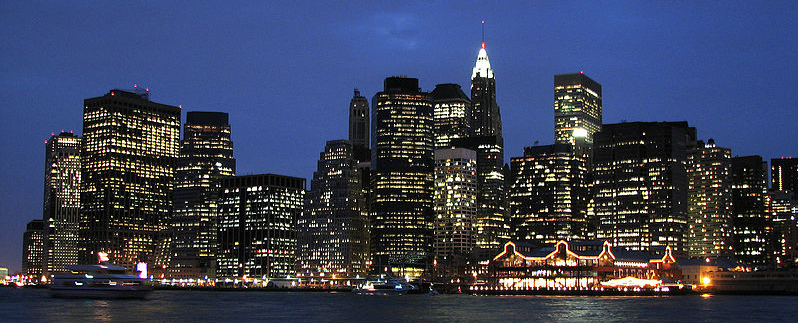
Evening is coming fast, and the great city is blazing there in your vision in its terrific frontal sweep and curtain of star-flung towers, now sown with the diamond pollen of a million lights, and the sun has set behind them, and the red light of fading day is painted upon the river - and you see the boats, the tugs, the barges passing, and the winglike swoop of bridges with exultant joy - and night has some and there are ships there - there are ships - and a wild intolerable longing in you that you cannot utter.


(from the short story No Door by Thomas Wolfe)


This excerpt from No Door seems to take place at a home in Brooklyn Heights on the palisade that faces the old docks on the East River and the skyline of lower Manhattan.  It’s the place where photographers take those panoramic photos of Manhattan for postcards and posters.  There’s a park with a wide sidewalk with benches.  You saw it in the movie Moonstruck when the grandfather took his dogs to howl at the moon. Nannies take children there in strollers and prams during the day.  Lovers patrol at night.

Of course, at the time Wolfe was describing the East River docks, there was still a great deal of manufacturing in Brooklyn, and the waterfront was much different.  There were many ships moving in and out of the docks with longshoremen on the wharves loading and unloading goods stored in the warehouses that are now renovated into condominiums.  

While he was writing the novel, Of Time and the River, Thomas Wolfe lived at 5 Montague Terrace, directly across the street from the houses that line the palisade (W.H. Auden lived two doors away at 1 Montague Terrace).  These houses were built by Wall Street tycoons who thought it more convenient to take the ferry to the Manhattan Battery in the morning than to drive down to Lower Manhattan from a house on Fifth Avenue. After the 1929 crash, many of the houses were abandoned, boarded up.  Brooklyn itself fell into a decrepit state and didn't recover until the 1980s.

But Wolfe was not living in Brooklyn Heights when he wrote No Door.  At that time Wolfe was living in the basement of a house at 40 Verandah Place.  The area was referred to as South Brooklyn then.  Modern realtors renamed it Cobble Hill.  Here’s what Thomas Wolfe wrote about his basement apartment on Verandah Place:


Well, you say, living alone in South Brooklyn has its drawbacks.  The place you live in is shaped just like a Pullman car, except it is not so long and has only one window at each end.  There are bars over the front window that your landlady has put there to keep the thugs in that sweet neighborhood from breaking in; in the winter the place is cold and dark, and sweats with clammy water; in the summer you do all the sweating yourself, but you do plenty of it, quite enough for anyone; the place gets hot as hell.  (from No Door)

In the photograph, you can see that the basement windows on the homes on Veranda Place are about 8 inches tall.  One hopes that the ceilings are higher because Wolfe was 6’5” and liked to stand as he wrote, using the top of his refrigerator as a desk top.

Thomas Wolfe captured New York more passionately than any writer I can imagine, describing mundane places, like the subway, with such accurate intensity that it can be felt as well as imagined:

Thus we streamed down from the free night into the tunnel’s stale and fetid air again, we swarmed and hurried across the floors of gray cement, we rushed and pushed our way along as furiously as if we ran a race with time, as if some great reward were to be won if we could save two minutes or as if we were hastening onward, as fast as we could go toward some glorious meeting, some happy and fortunate event, some goal of beauty, wealth, or love… (from Death the Proud Brother)


Thus, he engages us in the frenetic pace of the city.


The Parks Department gives literary walking tours about Brooklyn.  You can find more about the tours here:  http://www.nycgo.com/articles/brooklyn-literary-tour-nyc


post by Alana Cash