Showing posts with label Crime. Show all posts

Saturday, September 9, 2017

LABOR DAY WEST INDIAN DAY PARADE - J'OUVERT


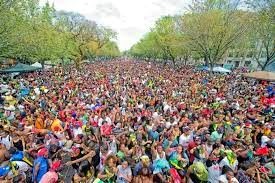
On Labor Day many of the residents of Brooklyn celebrate by marching or watching the West Indian American Day Parade. It's called J'Ouvert (day opening) and it's about expressing Caribbean culture. The marchers dress exotically and the spectators wave flags from their home country in the Caribbean. It's colorful and noisy and well-attended. I never saw it. I only heard it.


The Friday before Labor Day weekend, the police put spotlights at troublesome corners which they turned on every night as a sort of hint that NYPD would be present and watching. The day of the parade, there was a strong police presence at street corners and inside the subway stations. Ocean Avenue was barricaded at Parkside Ave. and at Eastern Bl. and many other streets blocked the same way. You could still enter Prospect Park on foot. I didn't go there either. I went to lunch in Queens with a friend.


The parade used to start at 4 a.m., but in a futile attempt to avoid violence, the parade start was pushed to 6 a.m. this year. There is a pre-parade of revelers with drums and whistles and horns that went down Flatbush about 5 a.m. The noise woke me and it was still dark outside, but I didn't look at the clock. It was distant - past the subway ditch and another block, but still it was enjoyable and short-lived - and I went back to sleep afterward. These revelers pass by and then go somewhere else and back to the beginning of the real parade.


The parade starts at Grand Army Plaza and marches down Flatbush to Empire Bl and turns there to continue marching. Then, I guess, there is partying in Crown Heights because I saw some fabulously feathered men and women late in the afternoon and evening walking down Ocean Avenue, presumably going home. That was a beautiful sight - hours and hours of exotic, tropical birds walking down the street.  No crowds and lots of smiling face. 


The extra security didn't prevent violence. At the beginning of the parade two men were shot (not killed) and another man was shot during the parade. Two other people were stabbed. In areas of Brooklyn not too far from the parade route, two men were shot to death. Fin du jour.

Thursday, June 30, 2016

MAFIA TOUR OF GREEN-WOOD CEMETERY


I used to watch crime dramas – most of them set in New York City or a backlot pretending to be NYC.  Brooklyn seemed like the headquarters for organized crime what with the waterfront, the construction unions and ghost payrolls, traveling dice games and the candy stores (more about that to come.).  The mafia was glamorized, although there were a lot of roly-poly guys.  

In researching and reading, I found there’s too much to put together with loads the different mobsters and their nicknames and where they lived and how they died.  I did cross paths with some Italians who might have been in the trade, but it sort of lost its luster when I met a man who grew up in Brooklyn and went to school with the sons of made men.  “They were bullies who liked to cause other people trouble because they could get away with it. And they are still bullies.”  He explained he was still was forced to hire people and do favors.  "You don’t say no if you want to stay in business,” he told me.

But still, it’s a part of Brooklyn history and while I can’t tell all of it, I did visit the graves of four mafioso who are buried at Green-Wood Cemetery.  Lesser known gangsters may be buried there too, but I don’t know their names.  Along with that, there was a funeral home in Brooklyn that made double coffins from time to time.  A murder victim was placed in the bottom of a coffin.  A nice satin-covered false bottom was laid over the murdered corpse, and the person for whom the family actually purchased the coffin was then laid on top of that.  How many murdered victims were disposed of this way in Green-Wood Cemetery or at any other cemetery in Brooklyn is a question for a reality show. 

This was my private tour **:

John Torrio (aka Johnny the Fox 1882-1957) has a nice walk-in tomb with an altar and a stained glass window.  John got lift-off in organized crime when he caught the eye of the leader of the Five Points Gant, Paul Kelly whose real name was Paolo Antonio Vaccerelli (guess he was trying to pass as Irish).  Kelly taught him to dress nicely, stop swearing, and establish a legitimate business, perhaps the importation of olive oil, as a front for his criminal activities.  Torrio in turn mentored Al Capone.

Jim Colosimo was married to Torrio’s Aunt Victoria a former madam in a brothel (I never said these people were classy), ran a huge prostitution business in Chicago and recruited Torrio to help out.  Torrio moved to Chicago and prospered.  When the Prohibition Amendment passed, Torrio wanted to sell bootleg liquor.  Colosimo didn’t, so Torrio arranged to have him murdered.  Torrio started bootlegging and controlled the Loop in Chicago.  When he attempted to expand beyond – by killing the leader of another gang, - members of that gang shot him five times.  He recovered, was arrested for violating Prohibition and sent to jail for a year. 

After release from prison, Torrio briefly moved his family to Italy, and left the business to Al Capone.  Torrio eventually moved his family back to Brooklyn where he ran a bail bond company (with Dutch Schultz).  Would you jump bail on a mob bondsman? 


In 1957, Torrio had a heart attack while he was sitting in a barber’s chair and went to his final rest at Green-Wood Cemetery.  The Torrio tomb is easy to find as it sits on one of the many little roads in Green-Wood – Canna Path.

[Torrio’s tomb is on the Green-Wood Cemetery Walk #1 – see below].

Joey Gallo (aka “Crazy Joe” 1929-1972) was born and raised in the Red Hook neighborhood of Brooklyn.  His father was a bootlegger and criminal who encouraged his three sons to develop their own criminal enterprises.  (What father doesn’t want that for his children?)  After an arrest in 1950, Joey was sent to the psychiatric ward at King’s County Hospital and thereafter had the nickname “Crazy Joe.” 

Joey became a top enforcer for the Profaci Family and worked gambling and extortion.  His headquarters was in his grandmother’s apartment in Red Hook. 
His career is really complicated with altercations with all sorts of members of various mafia families, but one notable event was the murder of a member of Joey’s crew, Joseph “Joe Jelly” Gioelli.  Gioelli’s clothes, stuffed with fish, were left on the sidewalk outside an establishment where Joey was sure to see them.  Later, a similar incident was described in The Godfather.

Joey went to Attica prison for ten years (1961-1971) for attempted extortion of a Brooklyn bar owner and was there during the Attica riot.  In prison he was diagnosed as schizophrenic.  When he was released, he moved from Brooklyn to Manhattan, living at 7 West 14th Street where he met Sina Essary.  Sina had been in a convent and ready to take her vows when she got pregnant, left the convent, married, divorced and then met Joey.  They got involved in the culture of the Village hobnobbing with artists and actors, including actor Jerry Orbach of Law & Order and Broadway fame.  There is no record that they ever met, but Bob Dylan recorded a song called “Joey” presenting Gallo as a semi-hero:   https://www.youtube.com/watch?v=zCCOQpx5ux4

Joey’s had enemies.  On his 43rd birthday in 1972 Sina, her 10 year old daughter, Joey’s sister Carmella and Joey stopped for a snack at the newly-opened Umberto’s Clam Bar** in Little Italy at 4 a.m.  While they were eating, Carmine “Sonny Pinto” DiBraise entered the restaurant with two other men and shot Joey, who staggered out to the sidewalk and collapsed on the corner of Hester and Mulberry Streets.  Thus Joey died.  

His funeral was a spectacle with hundreds of people lining the streets as his casket was driven to Green-Wood Cemetery.  Joey was buried next to his brother, Larry Gallo, a less colorful gangster who had died of cancer in 1968. 

The grave is a little difficult to find as it sits on a hillside which is covered in little bushes.

Joey Gallo claimed he murdered the 4th famous mobster known to be buried at Green-Wood Cemetery, .Alberto Anastasia
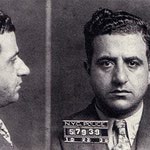

Anastasia was a founder of Murder, Inc., which operated out of a candy store in East New York, and arranged an estimated 400-1000 deaths in ten years.  Anastasia actually was seen killing several people himself, but the witnesses always disappeared, so he was never convicted.  While he was quite useful to the mob, Anastasia wasn’t well liked and he was shot to death in 1957 while he was sitting in a barber chair at the **Park Sheraton Hotel (renamed Park Central Hotel) at 870 Seventh Ave. in Manhattan.     

Anastasia had poorly-attended service at a funeral home – the Brooklyn Catholic diocese refused a church service – and he was interred on the flats of Green-Wood Cemetery with no friends or family buried nearby.  His grave is relatively easy to find because it’s off Lake Road, not too far from the main entrance.

I quit watching crime dramas because they just can't compete with the over-dramatised news which I don't watch either.


**There are self-guided tour books you can buy at Green-Wood – Torrio’s tomb is listed in Walk #1 and Anastasia’s grave is listed in Walk #2.


 **Umberto’s Clam House still exists and is located just down the block on Mulberry Street in Manhattan's Little Italy – I ate their once and recommend it.

**Gangster Arnold Rothstein was shot in one of the rooms of this same hotel.
Tuesday, August 11, 2015

ONLY THE DEAD KNOW BROOKLYN


photo by Mike Roseberry
New York has been portrayed for decades in movies and in television crime shows – from Peter Gunn with its jazzy Greenwich Village 1960s vibe (now in syndication) to Blue Bloods.  I used to see the TV production trucks in Brooklyn quiet a lot, especially Prospect Park.  It’s a lot easier to manage auto and people traffic in Brooklyn than Manhattan.  Crime shows glamorize the criminal justice system – it’s just entertainment with good guys and bad guys, just make believe.  That was my attitude until I started researching for a crime novel. 

My interest in writing a crime novel started when I met retired homicide detective Louis Scarcella at a coffee shop one morning.  He was sitting with some friends and one of them started talking to me.  They found out I was new to New York and asked me to join them again for coffee.  They were all retired from their careers, as I recall, and met there every morning. 

I like to write in coffee shops, and several days later, I met them again.  When Louie told me he had been a homicide detective, I asked if he’d be interested in helping me write a crime novel.  He agreed.  Louie, as it turned out, was one of the most decorated and lauded homicide detectives in New York City and many of his cases had made headlines.  For several months we met once a week.  He talked specifically about his cases and snitches,  and I asked lots of questions about police procedure. 

Louie arranged for me to talk to other (non-retired) homicide detectives and police officers.  Everyone had various stories and were forthcoming when I asked questions.  There was one common issue that they all spoke about – the smell of a dead body.  One retired police captain I met at Lincoln Center told me that whenever he was at the scene of a homicide, he used to take his uniform off and worked in his underwear because even dry cleaning didn’t get the smell off his clothes. 

Louie also arranged for me to visit the morgue so that I could understand for myself what they were all talking about.  Inside the building, I could smell the morgue rooms from 50 feet away, and I simply can’t describe it.  I was inside the rooms for about 5 minutes and the odor lingered on my clothes until I washed them.  I have to wonder now, what people on the subway thought about the scent as I traveled home that day.

The bodies inside the morgue were unclaimed.  These were not murder victims; they were people found in their own homes or on the street that no one had reported missing.  The morgue attendant said they would be held there for a few months, and if they were still unclaimed, they’d get buried in a City graveyard.   

The front room of the morgue held bodies on gurneys – one of them was a woman whose bloated body was a light blue.  The interior room did not have drawers, but rather stacked metal bunks.  All of them full and all the bodies were mine-shaft black.  I had seen dead bodies before in car accidents, but that was in passing, dramatic, momentary.  This was more real.  This would eventually happen to me.

I decided to research the decay of the human body and found out there’s a body farm in Knoxville, affiliated with the University of Tennessee.  People donate their bodies to science and their remains are sent to the farm where scientists put the bodies in the trunks of cars, into water, into closed containers, in plastic bags, or under a pile of leaves and study how these different elements affect the decomposition process.  They pass this information along to forensics and police labs (among others).  This type of information helps a Medical Examiner to determine time and cause of death. 

From my research I learned that as soon as the body dies, the bacteria in the stomach begin to eat away at it.  The gasses these bacteria give off rise to the surface of the skin causing the entire body to bloat and turn a beautiful light blue (whick was the stage of the female body in the morgue).  Then, as the gasses dissipate, the body begins to turn black.  During the final stages of decay the body is black as coal (bodies in the back room of the morgue had decomposed to this level).  It’s a mixture of gasses from the digestive system, various glands, as well as the decaying blood that gives such a strong, distinctive, and unpleasant odor.

About once a year when I was living in New York, a body was found in an apartment because the neighbors reported the smell.  One time the police responded to a call from a Park Avenue building and found that a woman (70s) and her mother (90s) had placed a man in a trunk after he died.  The woman explained that her husband had always wanted to visit Arizona and she and her mother had intended to send the trunk there, but they didn’t know how.  I don’t know where the trunk was sent, but the two women were sent to Bellevue.

But I digress.

After I’d learned as much about body decomposition as I could stand, I asked Louie questions about trials and testimony, he recommended that I sit in on a criminal trial in Brooklyn or Manhattan.  So I did.  The first was not a trial, but a hearing.  A 23-year old man had shot another man at a party over a girl.  The boy’s mother and younger brother (wearing red colors) were the only people in the courtroom gallery besides me.  I wondered, why did he have a gun at a party, where did he get it, when did he get it, did he always carry it.  That’s when I remembered something a cop told me once – you have to make 100 wrong decisions before you get arrested the first time.

I sat in on two criminal trials – one was the trial of a man arrested for possession of crack cocaine, the other was a trial about gang assault on a police officer.  Those trials changed my thinking forever about crime TV and caused me to lose interest in writing a crime novel.  A criminal lawyer I spoke to told me that the criminal justice system isn’t about innocence or guilt, it’s about luck.  Luck about who’s on the jury, who’s the judge, prosecutor, and defense attorney and what’s going on in their private lives.  You can be innocent and go to prison.  Guilty and be set free.  Luck.  Sitting in courtrooms of the criminal trials. I came to see the criminal justice system like an amoral perpetual-motion steamroller that squashes everything in its path. 

The man on trial for selling crack cocaine was on disability and testified that he worked for cash wages fixing cars.  He had four children, two of whom lived with him.  He asked someone to babysit for him while he went to visit a girlfriend and her teenage daughter.  The mother went off to buy vodka, the daughter went off to buy a soft drink, and he went off to buy some crack – just for his own personal use, he claimed.  He wanted to smoke a woolie – crack wrapped inside marijuana.  The woman who sold him the crack only had a few rocks, which he purchased and he asked her to go get some more.  She left.  He got arrested by an undercover cop.  I don’t know the verdict, because when the trial broke for lunch, I didn’t return.  The whole story was disheartening to me.    

In the other trial, the defendants were three men (23-24?) who had gone to Catholic school together and happened to run into each other at a bar on New Year’s Eve.  At least two of them were drinking heavily.  They had an altercation with an off-duty policeman who was not in uniform.  Differing versions of how that came about from either side, but all agreeing that the fight lasted about 45 seconds.  The men, who had no criminal record, were charged as a gang because New York law reads:  A person is guilty of gang assault in the second degree when, with intent to cause physical injury to another person and when aided by two or more other persons actually present, he causes serious physical injury to such person or to a third person.

They were all found guilty and two of them sentenced to fifteen years in prison.  The other one was sentenced to one year.

I stopped writing about crime.  

Over the past couple of years, several of Louie’s arrests and subsequent convictions have been overturned  – 8 so far – and those men who were in prison have been freed and given large payments of damages from the City (over $30 million so far).  Louie has been vilified, but I wonder about the prosecutors who worked those cases and ignored the flaws.  What about farther up the chain of command?  Who turned blind eyes in order to feed that perpetual-motion steamroller of the criminal justice system?  One person didn’t create this: