Showing posts with label Prospect Park. Show all posts

Wednesday, October 24, 2018

BROOKLYN OF AMPLE HILLS


Brooklyn of ample hills was mine.
Walt Whitman

Bensonhurst, Brooklyn circa 1900

I read that line a year ago and I stopped writing on this blog.  I had to think about the Brooklyn that was mine – it had changed quite a lot since I moved there.  The real estate developers frothed at the mouth since the Nets Stadium was built and my neighborhood, across the Park from Park Slope enticing with it's run-down buildings was screaming to them to be gentrified.

Now, the steel doors to the pre-war apartment buildings attempting to make them as impenetrable as a prison, were being replaced by glass ones. Exterior vestibules were being built, getting people out of the rain and snow faster and letting them drip in a vestibule instead of the lobby.  Lobbies were getting upgraded and the all elevators were working.  

Thank you, realtors, that Brooklyn is now the most expensive city in the US.  Higher than Manhattan?  Higher than San Francisco?  Seems impossible.

The shabby, stinky grocery at the corner of Lincoln Road and Flatbush Avenue is now a glassy, classy “health food” store.  The building that housed the Chinese restaurant that used to cook everything in the same grease for a week is torn down and a new apartment house is there with a big, clean, upscale grocery store (meaning produce is about 30% higher than any of the stalls on Flatbush) with it’s own overpriced hot and cold salad bar (I must admit the mashed potatoes are great).

There are new restaurants along Flatbush that open fully at the front so their music can blare out and attract customers that love having tinnitus in the morning.  And there are restaurants that are actually inviting – serving wonderful food and a staff with smiles who will turn the music down if you ask them (Gino's Italian at Lincoln Rd. and Flatbush - great lobster ravioli or Bonafini aka Blessings which serves all day, but try them for breakfast).

There’s a huge apartment building on Flatbush which defies the ordinance that you can’t build a building that can be seen from Prospect Park.  People in the park want to feel they have escaped the city and not feel king-konged by real estate developers.  Too bad now.

The Brooklyn I knew when I first moved there is becoming gentrified, but the Brooklyn that was mine will always be mine.  The Brooklyn of winter with that first snow-globe snowfall that brings the city to a whisper.  Followed by northers that make you feel that your eyeballs might freeze.  Christmas lights and decorations and toys displayed in the windows.  Brooklyn of heart-breaking spring days with small leaves on the trees and wildflowers (daffodils and irises) in the park.  The Brooklyn of summer with cool breezes, open windows, people playing dominoes on the sidewalk and that one horribly humid month of August.  Brooklyn of glorious fall.  The 100-foot trees across the street turning yellow and rust.  The sidewalk painted with red aspen leaves, brown oak and maple.  The umbrella of yellow leaves on trees in the park. The history, the pace and passion, neurosis, complaining, anger and aggressiveness.  The sound of the train in the ditch behind the house.  The endless walking past 100 year old houses and trying to hear their stories.  The varying cultures represented in clothing, behavior, accent, restaurants, body language.  

Brooklyn of ample hills was mine and I loved it.  I still love it, but now it’s a little bit slicker on the exterior and people spend a lot of time looking at their cell phones.  The old signs are gone – replaced with new ones.  But it's still got the garbage in the gutters.  And the noises of traffic and people.  Still, underneath, it's still got the Brooklyn that was Walt Whitman’s.

Prospect Park before it was Prospect Park
looking toward Brooklyn Museum circa 1900


Saturday, July 4, 2015

FOURTH OF JULY

When I realized that Revolutionary War battles were fought on the same ground that I walked every day, and seeing the Statue of Liberty every time I took the subway over the Manhattan Bridge into Chinatown, Independence Day took on a new meaning.  To celebrate, I liked to stroll through Prospect Park where General Sullivan battled the British back while George Washington escaped across the East River into Manhattan.

The park streets are closed to traffic on holidays and weekends and instead are filled with bike riders (some of them travelling at Tour de France speed), as well as families with kids and strollers.  Some people liked to get out on the lake in paddle boats and canoes.  Some fished from the lakeshore – although I can’t imagine eating anything out of that lake.  The Prospect Park drum circle was active.  Extended families and their friends from all over Brooklyn arrived with barbecues and cooked from morning till the park closed at dusk.  


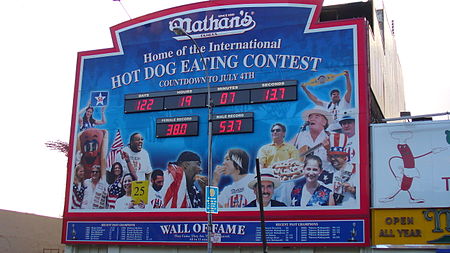
Down at Coney Island, the birth of our country is celebrated each year with the Nathan’s Hotdog Eating Championship.  The winners generally eat over 60 dogs, which is difficult to imagine unless you actually see it happen.  Hotdog eaters have to qualify to enter.  There are 12 cities around the country that have preliminary contests (mostly in June) and those winners go to New York for the national championship.  It’s a big deal.  There’s even a Hall of Fame.


Starting a bit before 10 pm, for the second year, there’s a fireworks display at Coney Island specially for 4th of July (there are regular fireworks displays every Friday on the beach at Coney Island during the summer, which is a great treat if you happen to be at Cyclone’s Stadium for a ballgame).  But I preferred to stand on the window seat in my apartment and watch the fireworks launched over the East River.

After the major (and legal) displays, fireworks continued to go off in the neighborhood until the early morning hours.  Some of them were possibly cars backfiring and some possibly gunshots judging by the constant sirens during the night.  But eventually, about 3 am, things got quiet enough to sleep.

post by Alana Cash

Tuesday, June 10, 2014

LEFFERTS GARDENS

The neighborhood behind the house was called Lefferts Gardens.  It used to be part of Flatbush, but the realtors carved up Brooklyn into ever smaller neighborhoods because they could only gentrify so much at a time.

In this part of Brooklyn, like most others, there were lots of row houses and pre-war apartment buildings (this term is used to delineate apartments built before World War II. They have bigger rooms, bigger casement windows, solid wood doors and oak floors.

Originally settled by Native Americans, then the Dutch, this area had also been an Italian and Jewish neighborhood where Rudy Guliani, Barbra Streisand, and Lanie Kazan grew up.  When I moved there, it was 90% black - populated African Americans and Caribbean and African immigrants.

It was kind of “me and them” at first  A few times I got called derogatory names, usually preceded by the word “white,” until I finally explained that no one had to tell me that because I already knew I was white.  I was sticking-out-like-a-sore-thumb white.  Everyone settled down after a while, or maybe it was just me.  

I found that young black men were the most polite and respectful people I ever met in any part of Brooklyn, or Manhattan either for that matter..  The subway clerks, behind those bulletproof glass windows, set the tone for rudeness in the City or anywhere in the world in my opinion.  And the Brooklyn US Postal employees (also behind bulletproof glass) can be distinctly rude.  But I digress.

The sidewalks were crowded and people in that neighborhood liked to walk side by side with their friends – stretching five or six people across  – so that sometimes I had to step into the street to get around.  The streets were very dirty and noisy, too, because a lot of the stores played music for their customers and some stores sold music and were particularly loud.  When I say stores, some of these places were 4 feet wide and 6 or 8 feet deep – like a walk-in closet. 

The roads were not what you would find in Manhattan.  Some potholes were the size of a bathtub and half as deep.  Bad news if you are on a bike.  And the tar in the streets was melted and pushed into waves in the street.  There were “gypsy cabs” – these were private cars and vans that had not obtained a hack license from the city.  They transported people around the neighborhood and people recognized and flagged them down. 

There were also disguised police vehicles – beat-up vans or old Toyotas with mismatched doors.  I’d be at a corner waiting for the signal to change and all of a sudden one of those crappy looking vehicles would pull out a flashing cherry light, hit the hammer (siren), and take off after someone.  It was funny.

Most of the stores were built into the ground floor of old houses that you wouldn’t even notice if you weren’t looking.  The two upper floors were rented out as apartments or used for storage and some of them still had the painted brick advertisements from the 1950s.  To me, Flatbush Avenue was for exploring history and architecture, but not the best place for that in Brooklyn.


Post by Alana Cash

Monday, May 26, 2014

PROSPECT PARK - setting the tone

When I arrived in New York, all I knew about Brooklyn was what I'd read about in the novel, A Tree Grows in Brooklyn.
Prospect Park
That novel takes place in Williamsburg, a neighborhood in the north part of the borough near Queens, and of course. I intended to scout the neighborhood described in that novel, and eventually I did.  But before living in Brooklyn, I had no idea how multi-textured nor how historic it was. That awareness began with my first visit to Prospect Park.

I lived directly across the street from the park, 300 acres of idyllic landscape, meadows, trees, and waterways designed by Frederick Olmstead and Calvert Vaux who also designed Central Park.  [Olmstead was also on the board of the Yellowstone Park Committee when it was being designated a national park.]

When I first moved to Brooklyn, before I had a bike, I took long walks -- by that I mean 5-10 miles at a stretch.  It was only when I got planta fasciitis that I got the bike and started riding everywhere.  At any rate, there is a drive encompasses Prospect Park.  On my second day in Brooklyn,  I walked around it.  My dad's farm was 300 acres and that walk was the first time I had a handle on the size of his land.

About a quarter mile along East Drive, I noticed a sign and walked over to read it. 

HISTORIC MARKER OF BATTLE PASS
At this point the Old Porte Road or Valley Grove Road
intersected the line of hills separating Flatbush [Village] from
Brooklyn and Gowanus, in the Battle of Long Island,
August 27, 1776...

Suddenly, all that American history I'd studied in high school was made real as I fully comprehended that I was standing on ground where a battle in the Revolutionary War had taken place.  This battle was the first to take place after the Declaration of Independence was declared and the largest of the Revolutionary War.  Around me was hundreds of years of history of the beginning of my country. Where had the revolutionary soldiers camped?  Where had they crouched to aim? Where had they died and been buried?


Doing some immediate research that day on the Internet, I learned that the Hessian (German mercenary) troops and British troops had approach Battle Pass from where they'd landed at Gravesend Bay to the south.  They traveled through Flatbush Village and crossed over the land where the house I was living in now stood.  For all I knew, British troops had camped in what was now the yard.

I stood at the window of my living quarters thinking, the Revolutionary War happened right here, where I am, where I am looking.

There was history everywhere in Brooklyn, and I was determined to find it.

You can read more about the history of Prospect Park here:
http://www.echonyc.com/~parks/books/handbook.html