Showing posts with label Adultery. Show all posts

Tuesday, February 28, 2017

LADY RANDOLPH CHURCHILL, BROOKLYNITE

If you watched Downton Abbey, then you know that many of the great British estates were saved from the auction block and the lords who owned them were saved from bankruptcy by fortuitous marriages to American heiresses. Not just any old American heiresses, but the cream of the crop. Daughter of William K. Vanderbilt, Consuelo Vanderbilt, married Charles Churchill to become the Duchess of Marlboro, and her friend, Jeanette (Jennie) Jerome, married Charles' younger brother Lord Randolph Churchill.
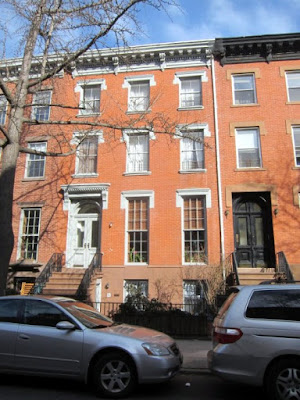
Lady Randolph Churchill née Jeanette Jerome (aka Jennie) was born in Brooklyn, more precisely, at 426 Henry Street. There's a plaque commemorating her birth there, although that was not her family's home. The mythology is that her uncle lived at Henry Street and the Jerome's were visiting when Clara Jerome went into labor. The Jerome's, at that time lived nearby in a brick row house at 8 Amity Street which has been renumbered as 197 Amity Street. It's bit confusing, and there is also some confusion as to the spelling of her name - Jenny or Jennie?

Jennie's father, Leonard Jerome, lost and made several fortunes in his career and must have been between fortunes at the time of Jennie was born. He became a speculator in railroads and whatnot with Cornelius Vanderbilt and became rich again so that a few years after Jennie's birth, Jerome moved his wife and daughters to a house in Manhattan at the corner of 26th St. and Madison Avenue. It was a very big house. The breakfast room could hold 70 people. My. That house was torn down in 1967, lasting over 100 years. [William K. Vanderbilt had a similarly-sized house at the corner of 5th Avenue and 51st Street]

Jerome loved horses and partnered with the Commodore's son, William K. Vanderbilt (Consuelo's father), to start the American Jockey Club, the Coney Island Jockey Club, and build a racetrack in Brooklyn. The Sheepshead Bay Race Track is now disappeared into real estateville although Jerome Street in still runs between 16th St. and 22nd St. Jerome and August Belmont also built a race track in the Bronx where they held the first Belmont Stakes in 1867 (Belmont Stakes is now held at Belmont Park on Long Island).

Jerome was lavishly generous with his wife and daughters and encouraged them to enjoy life, something Jennie would take to heart. Along with her mother and sisters, Jennie spent summers in France, which is where Jennie met Lord Randolph Churchill. The story is that they got engaged three days after they met, but the dowry settlement took months to a negotiate because Randolph's mother disliked Jennie and wasn't about to sell her son into marriage for a pittance. As soon as the dowry contract was signed, Randolph and Jennie married quietly, and their son Winston Churchill was born prematurely 7 months later.

After the Lord Randolph Churchill's had two children, Randolph became ill (it isn't proven, but claimed that he died of syphilis - could have been a brain tumor). Jennie began to take after her philandering father. She had affairs with the German Kaiser, the future king of England and other powerful men who woud later help further Winston's career.

After Randolph died, forty-one year old Jennie remained in England and married George Cornwallis-West, a man 20 years younger than she. They divorced and a few years later, she married Montagu Phippen Porch, a civil servant 23 years younger than she.

Her young husband was in Africa when Jennie had a fall that broke her anke. She was wearing high heeled shoes and slipped on the stairs at a friend's home. The break was tremendous and the ankle gangrened. Jennie's leg was amputated above the knee, apparently not in a skilled manner, because shortly after the surgery an artery in her thigh hemorrhaged and she died in 1821 at 67 years of age.

Jennie Jerome, Lady Randolph Churchill was buried in the Churchill family plot in Oxforshire.


[Leonard Jerome, by the way, was interred at Green-wood Cemetery in Brooklyn.]


Friday, December 4, 2015

INNOCENTS ABROAD – GUILTY AT HOME


Plymouth Church was founded by 21 people in 1827 and its first minister was the fiery aboliltionist, Henry Ward Beecher.  The church is still open and operating at 124 Henry Street in Brooklyn Heights.

Plymouth Church was part of the Underground Railroad and the Beecher regularly gave sermons in which he appealed for financial donations to purchase the freedom of slaves.  He held mock slave auctions and women took the jewelry off their fingers, wrists, and necks and placed it in the offering basket. 

In the 19th century, the church was so well known throughout the country that Abraham Lincoln attended services at Plymouth Church in 1860.  His pew is marked with a plaque.  Charles Dickens gave a talk at Plymouth Church.  Mark Twain travelled to Europe for several months with a group of church members and chronicled their journey in his book The Innocents Abroad, which by the way, I highly recommend. 

Beecher’s salary was $100,000 a year – over $2,000,000 in today’s currency.  Considering that a Union solider earned $15 a month, this made Beecher quite a big cheese. Beecher’s powerful charisma especially appealed to women and he was prone to affairs with congregation members.  One affair, the one with Elizabeth Tilton, would become a public scandal and that wasn’t just because her husband Theodore Tilton was Beecher’s best friend.  How and why that scandal erupted has to do with the interwoven lives of the movers and shakers of Old New York. 

Henry Ward Beecher presided at the marriage of Elizabeth Richards and Theodore Tilton.  Beecher and Tilton together edited The Independent newspaper.  They were both ardent abolitionist speakers and sought-after on the lecture circuit – the 19th Century equivalent of TV.  They were both out of town often, but not at the same time. 

After the abolition of slavery, they needed other causes for their zeal.  Tilton became an intense advocate for divorce reform (making it easier to obtain) and women’s emancipation.  There’s some irony here.  Beecher was also supportive of the women’s suffrage movement, but not so much in favor of divorce reform.  He also spoke out against the concept of “free love” (he was against the idea that women should be allowed to choose their sex partners) which was promoted by some women in the feminist movement of that era.  The staunchest advocate for free love, Victoria Woodhull, made note of Beecher’s feelings.

Woodhull was a barely educated entrepreneurial type who worked as a medium and magnetic healer until she and her sister met the recently widowed Cornelius Vanderbilt who set them up at 44 Broad Street as the first female stock brokers – Woodhull & Claflins Co.  Soon after, the sisters created the first newspaper run by women Woodhull & Claflin’s Weekly.  And, for the hat trick, in 1872, Woodhull was the first woman to run for president.

But I digress.

Beecher was used to visiting the Tilton home and it didn’t appear out of line for him to visit Elizabeth when Theodore was away.  One thing led to another as it often can, and Elizabeth eventually confessed to her husband that she’d been unfaithful to him with Beecher.   Naturally upset, Theodore mentioned this affair to his friend Elizabeth Cady Stanton, who relayed the news to Victoria Woodhull who took it upon herself to publish an article about it in her newspaper and label Beecher a hypocrite.  Imagine that. 

Beecher was wise enough not to sue for libel.  However, Woodhull was arrested for mailing salacious material.  In other words, because she mailed out her newspaper to subscribers, and because the article was sexual in nature, she was jailed.  When Elizabeth Tilton was questioned and confessed her affair to the police Woodhull was released after a month.  [Adding more irony to the story, Theodore Tilton is rumored to have been a lover of Victoria Woodhull during his marriage.]

It took until 1875 – somewhere in the neighborhood of seven years – for Theodore Tilton to finally sue Beecher for “criminal conversation” adultery (basically meaning debauchery of Elizabeth) and “alienation of affection.”  At the trial, Elizabeth made a short statement of confession.  Beecher, however, declared in inimitable political sidestepping, that perhaps Mrs. Tilton had sexual relations with him but he had not had sex with her.  This sounds awfully familiar.  His lawyers argued for his reputation being ruined and that should Beecher be convicted, middle class values would be thrown into chaos.  More double speak. The lawsuit ended in a hung jury and Theodore dropped his suit.

Theodore Tilton moved to Paris leaving Elizabeth to live in poverty, scorned by the Plymouth Church congregation, and buried in an unmarked grave at Green-Wood Cemetery.  Beecher lived on in the same status as before, actually got a raise in salary, and there’s a big statue of him not far from Plymouth Church on Cadman Square in downtown Brooklyn (see above).

.

Monday, June 30, 2014

GREEN-WOOD CEMETERY'S BATTLE HILL

In a little alcove at the front entrance to Green-Wood Cemetery is a computer where you can enter the name of a person whose grave you would like to visit and you will get a print-out map showing that location.  There are walking tours regularly, but you can buy a guide books and take your own tour.  One book is a guide for walking the south side of the cemetery and the other book covers the north side.  


When I offered to teach a writing class at Green-Wood, I was treated to a private tour by Lisa Alpert and we went inside the Receiving Tomb.  This is a huge barn-like structure with shelving.  In the winter when the ground was too hard for digging, the deceased were stored there in their coffins until spring.  As I recall it would hold 1500 coffins.  

We also went inside the chapel.
From the chapel, we traveled to an area on the north side of the cemetery called Battle Hill.  This is the highest natural point in Brooklyn and was another site of the Battle of Brooklyn during the Revolutionary War.  

Charles Higgins, who was successful at manufacturing India ink, bought a large plot of land there for his tomb. Higgins also commissioned and an Altar of Liberty to commemorate the Battle of Brooklyn as well as a statue of Minerva, the Roman goddess of war.  The statue of Minerva has a raised arm pointing toward the Statue of Liberty in New York Harbor.

Buried a few feet from Higgins is my favorite person in Green-Wood Cemetery. Her grave market states simply, “Grandmother,” and her name is Elizabeth Tilton.  She figured in a very disastrous scandal along with her husband, Theodore Tilton, and Henry Ward Beecher.

The Tilton’s were members of the Plymouth Church in downtown Brooklyn where Beecher served as minister.  Theodore and Beecher were very close friends and worked together on a newspaper, “The Independent,” with Theodore acting as editorial assistant to Beecher who was editor.

Theodore was an abolitionist, an advocate of free love, and a bit of a bully to his fragile wife.  Apparently, he dallied in free love when he was away on his lengthy lecture tours.  The charismatic Beecher, who claimed to more than one woman that he had no marital relations with his own wife, visited and comforted Elizabeth while Theodore was away. 

Elizabeth was a Sunday school teacher and, apparently out of guilt, confessed to Theodore about the affair.  At first, Theodore and Beecher convinced Elizabeth to stifle herself.  But Victoria Woodhull heard the rumor and published that news in her paper.  Out of vanity, Theodore sued Beecher for “criminal conversation,” a polite term for adultery.  Elizabeth gave a statement to the court, but did not testify.

There was a trial and a hung jury.  Afterward, Beecher was awarded a raise in salary by the (all-male) church board - $100,000 a year.  Quite a sum in the 19th century.  Elizabeth confessed the affair again, this time to the church, and was ostracized from the church and community.  Her husband left for Paris, and she lived in poverty to her death.

Post by Alana Cash